It is 9:40 on a Sunday night and your phone rings.
It is the shop. A customer is standing there asking whether the order that was supposed to come on Friday has been dispatched. Nobody in the building knows. So they called you — because you are the only person who does.
You find the answer. You always do. But the real problem is not this order.
It is that they had to call you at all.
Your business runs on your memory
Every growing business has a system. Most owners just do not realise that the system is them.
The stock number that matters is the one in your head. The credit you extended because you knew the man's father is not written anywhere. What you actually promised that buyer on the call — all of it lives in one place, and that place is you.
So you cannot be ill. Not properly. A holiday is four days of drift and a week of repair, so eventually you stop bothering. And the business can only grow as large as your attention. You are not running out of ambition. You are running out of head.
There is a quieter cost. Somewhere along the way you started to feel your team does not take ownership — that they call you instead of thinking. That feeling is corrosive and mostly unfair. They call you because you are the only reliable source of truth in the building.
If you run a team rather than the company, you know a smaller version of this. Your morning goes to discovering what happened yesterday. You chase updates that should have arrived on their own. You spend the day as a relay — information up, instructions down — and call a meeting mostly to collect facts a system should already hold.
You are the system too. For your team.
Every business is four things — and always has been
Strip away the industry and the century, and every business operation reduces to four things.
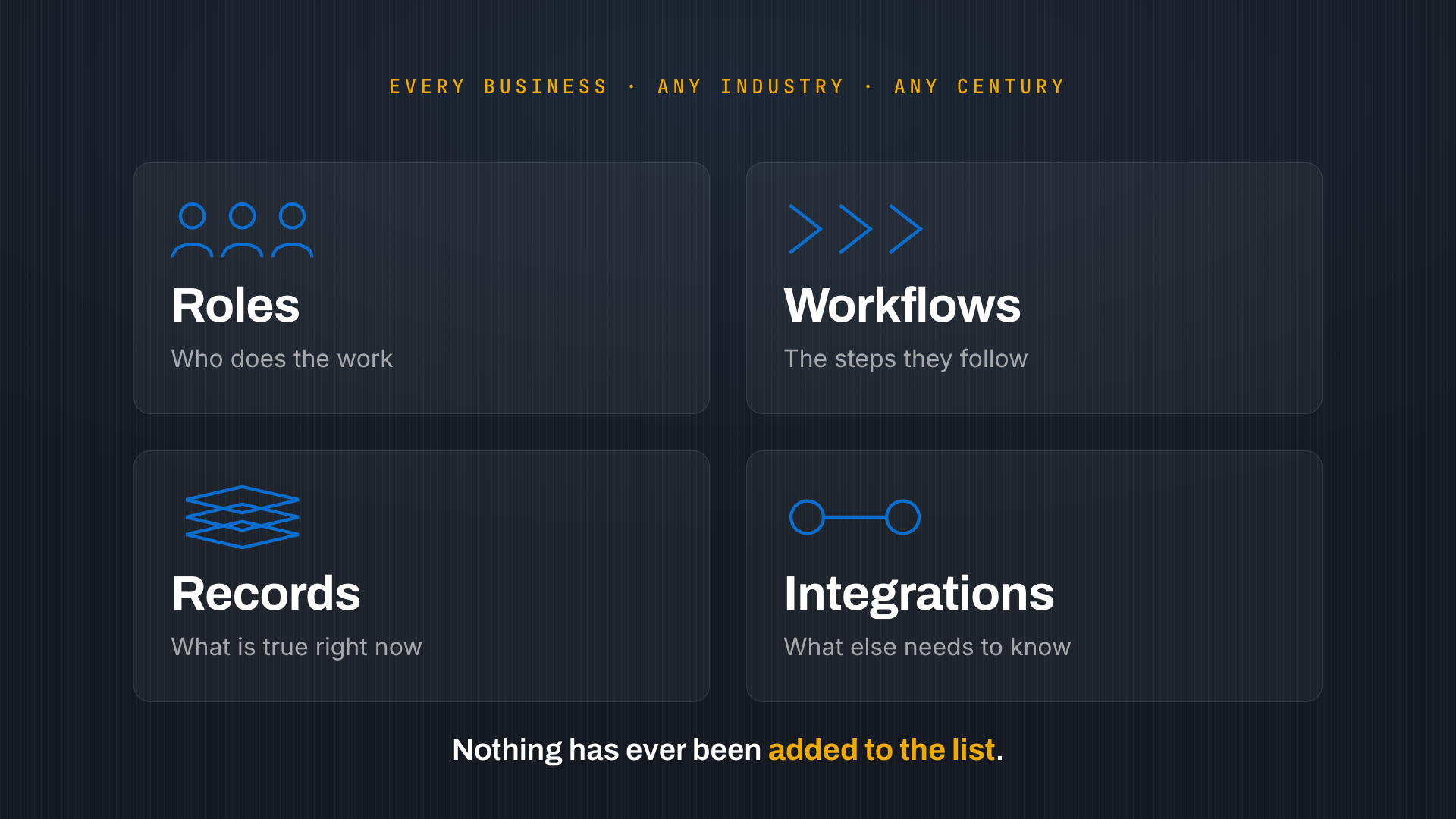
Roles — who does the work. Workflows — the steps they follow, in order. Records — what is true right now. Integrations — what else needs to know.
None of this is new. A grain trader in a bazaar three thousand years ago had all four: roles (himself, his son, the porter), workflows (buy, store, sell, collect), records (his memory, later marks in clay), and integrations (the moneylender, the shipowner, the man who came for the tax).
A company with two hundred factories today has exactly the same four. Nothing has ever been added to the list.
So if all four have been constant for three thousand years, what separates that trader from the modern corporation?
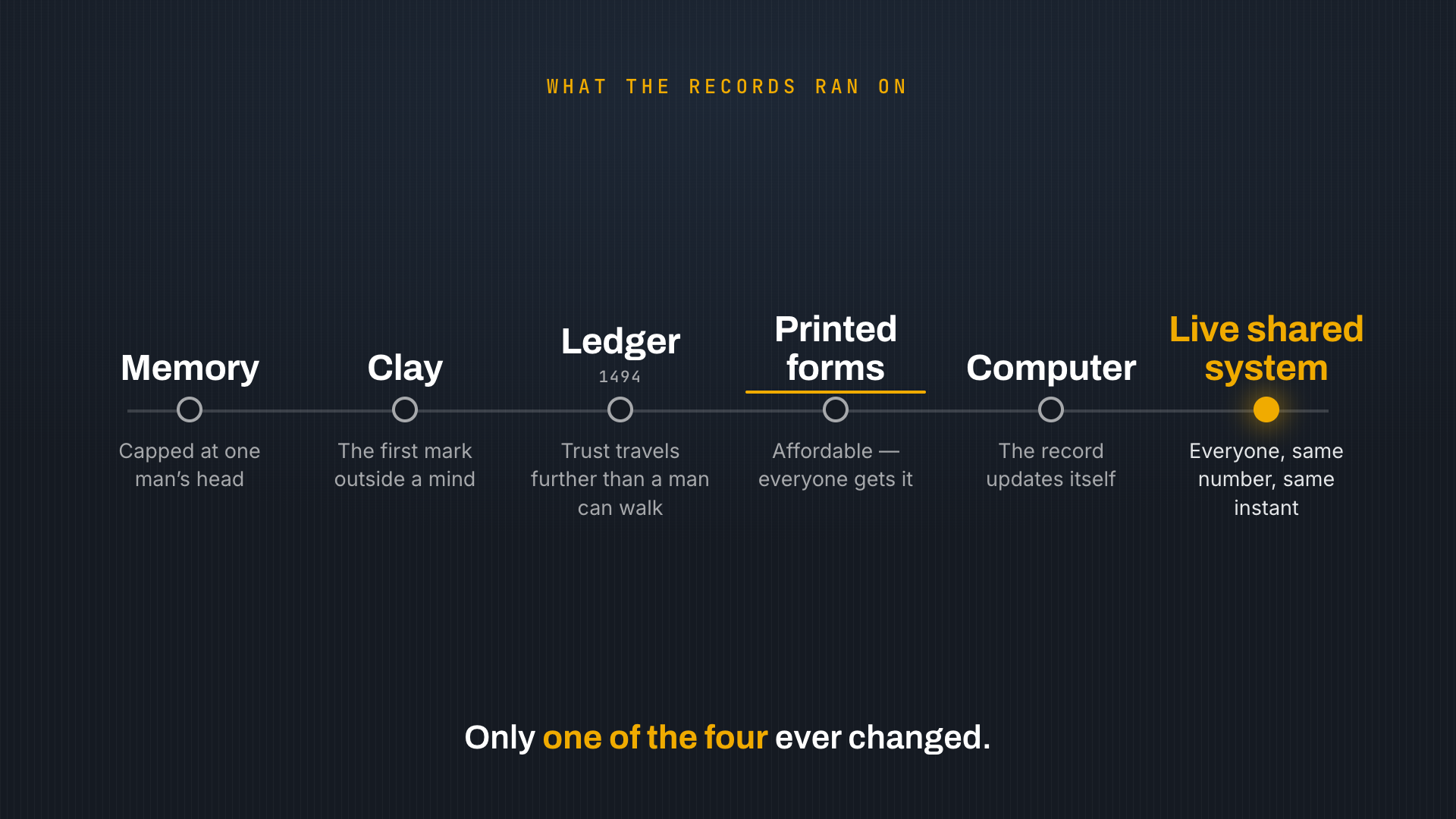
One thing. What the records run on.
Memory came first, and it capped a business at the size of one man's head. Then the ledger — the first time records lived outside a human being. It could be checked; it could outlive him; someone else could run the shop on Tuesday. By 1494, when a Venetian friar set down double-entry bookkeeping, merchants had used it for generations to trade across seas they would never personally cross. The ledger let trust travel further than a man could walk. Then printing made the forms cheap, and the technology that built merchant empires reached every small shop in the world — because it became affordable.
Hold on to that pattern. It happens again.
Your records are on the wrong medium
Your roles are fine; they existed the day you opened. Your workflows are real and they work — not written down, but your team knows exactly what happens to an order. Your integrations mostly happen by hand: someone types the day's figures into the accounting software.
And your records run on human memory, one person's Excel sheet, and a WhatsApp group.
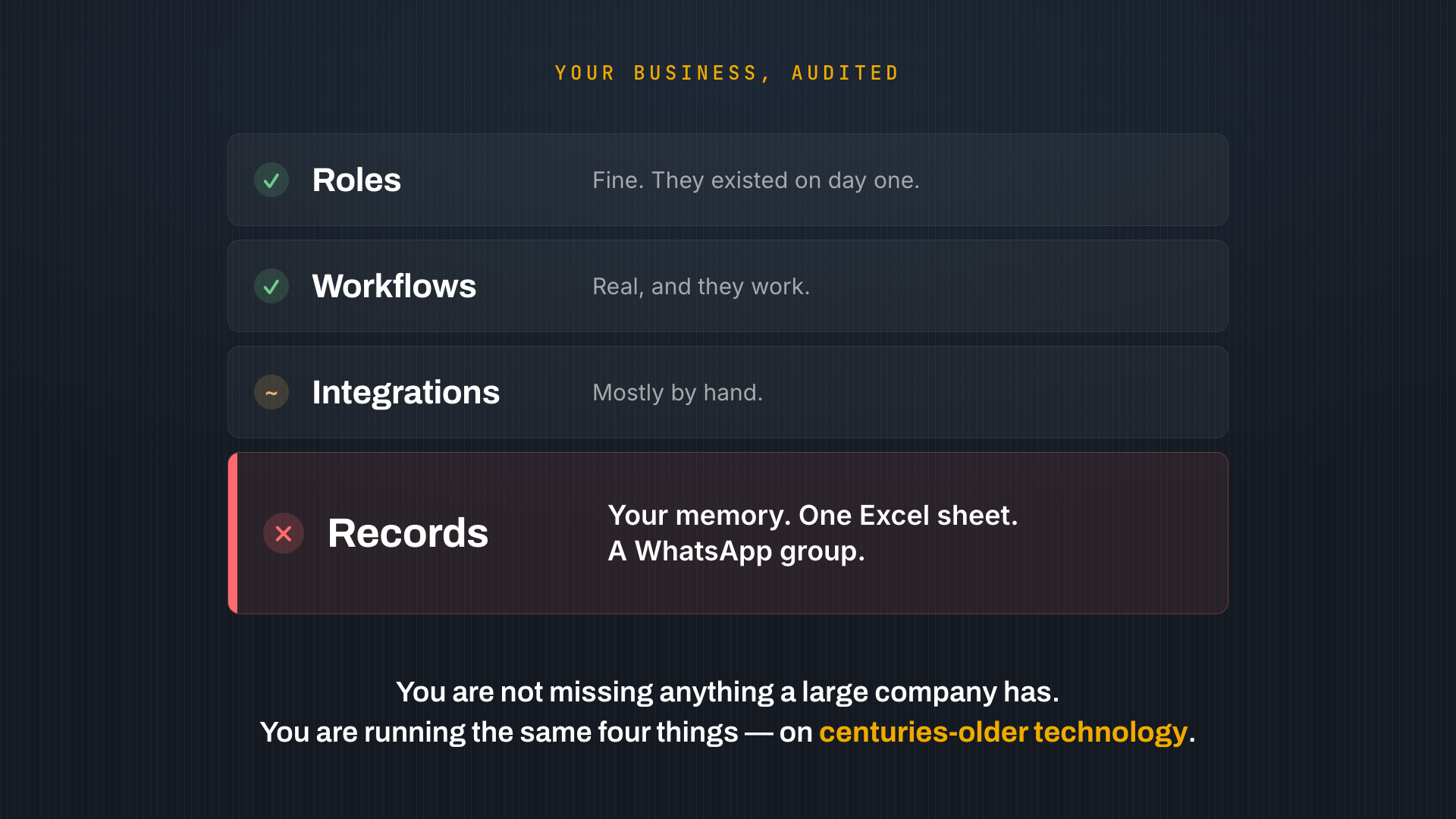
You are not missing anything a large company has. You are running the same four things they are — on technology that is centuries older.
That is the entire explanation for the first half of this article. When the records run on memory, a human being has to be the record. That human is you. You cannot take a holiday because the record cannot. Your team calls you because you are the database.
You do not have a management problem. Your records are on the wrong medium.
It follows that most of your "communication" is not communication at all — the 9:40 call, the WhatsApp group, the morning meeting that exists to discover what happened. It is people synchronising records by voice, because the records cannot synchronise themselves. Every WhatsApp group in your business is a workaround for a record that does not update — which is why a better chat tool changes nothing. A faster relay is still a relay.
Why big companies never lose track
From outside, a company with two hundred factories looks like it runs on managers who never lose track of anything. It does not. It runs on infrastructure.
They did not get better roles than you, or smarter workflows. They moved their records onto a medium that updates itself. The plant manager, the warehouse in another country and the finance head all write into the same record, so they see the same number at the same instant. Nobody has to be asked. Nobody has to remember.
The difference between them and you is not care — you almost certainly care more, it is your name on the building. The difference is the medium.
And that medium was priced for giants: licences per user forever, months of rollout, an IT team to own it. Reasonable at four thousand people, impossible at forty. So most of the economy never got the upgrade — not because it needed it less, but because in a large company one person leaving is an inconvenience and in yours it is a crisis.
Three things changed that. Everyone already carries the terminal. Software no longer starts from zero, because those four primitives repeat across every business — the plumbing is 60–70% the same whether you distribute batteries or run a supermarket. And the apps got smaller.
What a micro app actually is
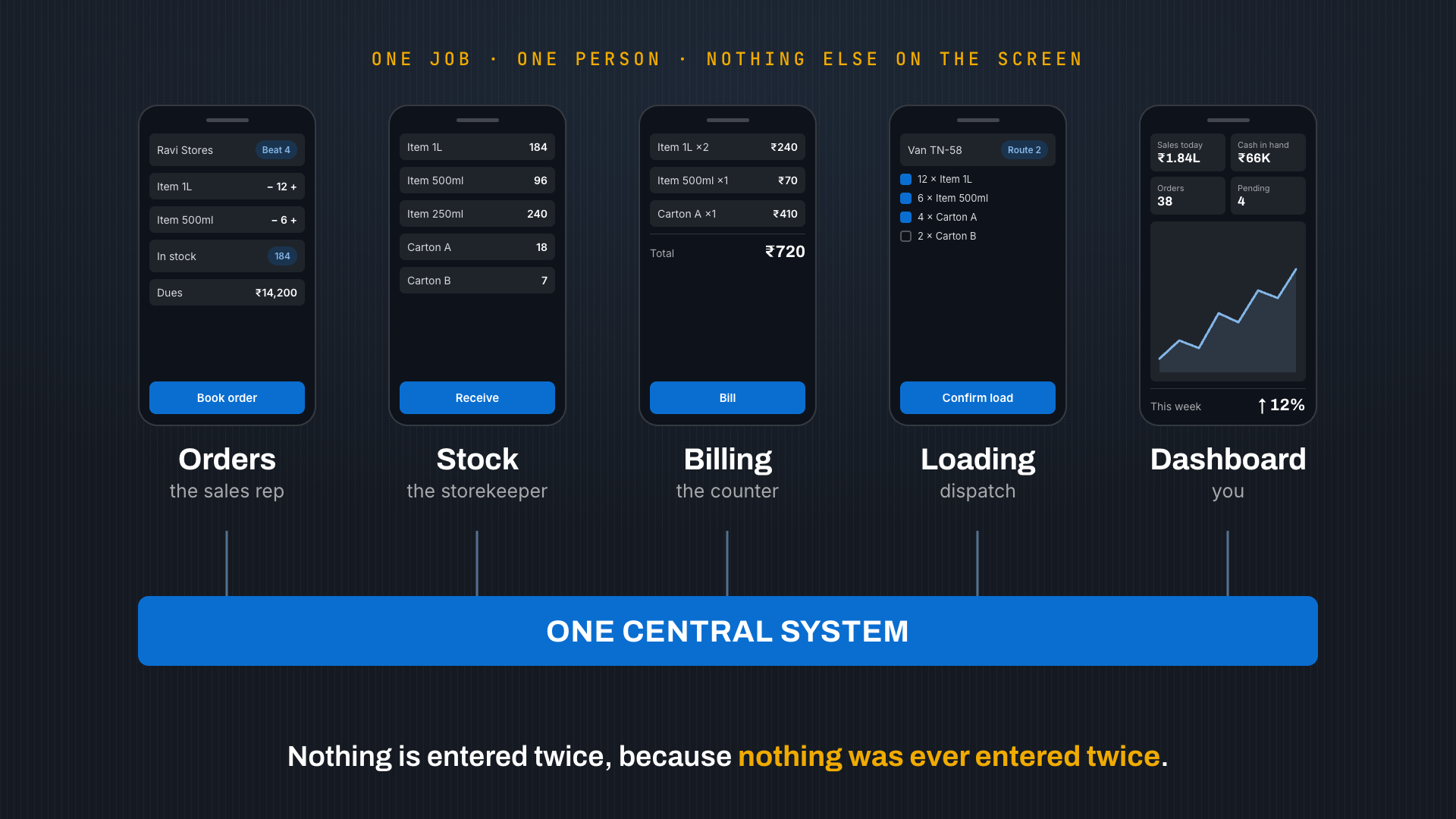
A micro app is one role doing one workflow, writing into shared records, with integrations underneath. One job, one person, nothing else on the screen.
In a distribution business, five of them:
- Orders for the sales rep — books on the beat, sees live stock and dues
- Stock for the storekeeper — receives, counts, issues
- Billing at the counter — bills in seconds
- Loading for dispatch — right goods, right van, tracked to delivery
- Dashboard for you — the whole business in one view, from anywhere
Five roles. Five workflows. One shared set of records underneath — which is what makes it a system rather than five disconnected apps. The rep books an order and the storekeeper's number moves. The counter raises a bill and your dashboard updates. Nothing is entered twice, because nothing was ever entered twice.
A new hire uses one on day one without training, because there is only one job on the screen. They install from a link you send on WhatsApp — no app store, no rollout — and keep working when the signal drops at the back of the godown.
Your roles did not change. Your workflows did not change. Only the medium did.
What changes when records keep themselves
Go back to Sunday night. The customer asks about his order. The person at the shop opens one app and answers him.
Your phone does not ring.
That is the whole point. Not efficiency — that word is too small. The business stops living inside your head. You can be ill. You can go to the wedding.
If you run a team, the change is sharper still. Coordination stops being chasing — you see what is done and what is pending without asking anyone. Alignment stops being a meeting — your team looks at the same records you do, at the same moment, so priorities do not need re-explaining. And your people can act without asking. You cannot empower someone you keep in the dark; telling a person to take ownership while withholding what they need to own it is just pressure.
You also, finally, see who is doing the work — not who is loudest in the meeting, but who actually moved things.
A business that can run without you is the only kind you can ever grow, sell, or hand to your children.
Where Systemo fits
We build micro apps as one system, for businesses between 20 and 200 people across Tamil Nadu, Kerala and Karnataka.
We start by writing down the four things your business already has — your roles, your workflows, the records that should outlive anyone's memory, and the systems that must stay in sync. Then we build from proven blueprints rather than a blank page, which is why it costs roughly 60% less and goes live about 50% faster than conventional custom development. Weeks, not quarters. And you click through a working prototype of your own system before anything is built.
The ledger belonged only to merchants until printing made it everyone's. Records that keep themselves have belonged only to large companies for forty years.
That is the part that is ending.
Introducing micro apps — the new way to run your business.